
Swiss, explained.
Nobody is knocked out. Each round you play someone on the same score, and nobody plays the same opponent twice.
A Swiss system tournament plays a set number of rounds and knocks nobody out. Each round pairs players on the same score, and nobody meets the same opponent twice. After the last round the table decides the winner, or the top players play a knockout. Thirty-two players need only five rounds to find one unbeaten player.
How it plays.
Round one
Paired by seed: the top half plays the bottom half, so the strongest don’t meet straight away.
Paired by score
Each round is paired once the last one finishes: winners play winners, losers play losers.
No rematches
Nobody plays the same opponent twice. With an odd number, one player has a bye, never the same player twice.
The finish
After the last round the table decides, split by tie-breaks, or the top of the table plays a knockout.
How long it takes.
The rounds grow by one each time the field doubles, which is why big events use it.
| Players | Rounds | Matches | Each player plays |
|---|---|---|---|
| 8 | 3 | 12 | 3 |
| 16 | 4 | 32 | 4 |
| 32 | 5 | 80 | 5 |
When to pick a Swiss.
Good for
- A big field that wants a real winner without a long knockout
- Everyone playing every round, whatever their results
- Rounds spread over weeks, paired as they go
Think twice about
- A small group: a round robin is simpler and fairer
- Players who want to know every fixture up front
- Paper and a pen: each round’s pairings take working out
Running it on Leadrboard®.
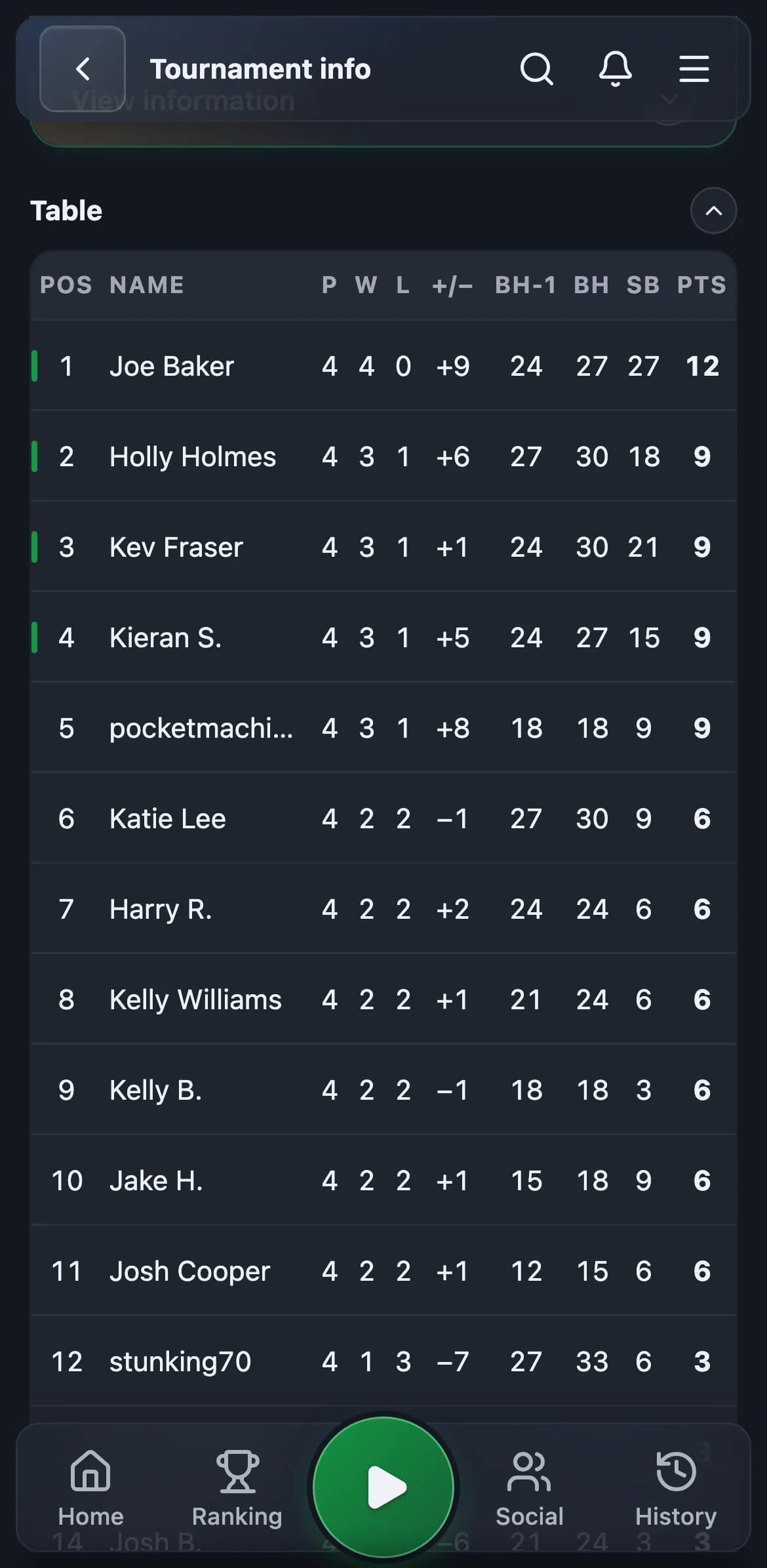
Leadrboard® pairs each round when the last one is settled, and keeps the table with its tie-breaks.
How it ends
A set number of rounds (Auto picks enough to find a winner), or play until players reach a number of wins (through) or losses (out).
A top cut
No knockout: the table decides, or a knockout for the top of the table.
Pairing
Top half v bottom half (the default), Neighbours or First v last, with accelerated pairings to bring the leaders together sooner.
Byes
A bye counts as a win by default, or a draw or a loss if you set it.
Swiss tie-breaks
Buchholz cut 1, then Buchholz, then Sonneborn-Berger, then Head to head, then Frame difference by default, worked out from the opponents each player met.
Check before it’s out
Release each round straight away, or check it as a draft, swap two players, then publish.
Questions.
How many rounds does a Swiss need?
Enough that only one player can win them all: 3 rounds for up to 8 players, 4 for up to 16, 5 for up to 32. That’s the same as the rounds of a knockout of that size, but nobody goes home.
What is Buchholz?
A Swiss tie-break: the total points of every opponent you played. Two players level on points have usually met different opponents, and Buchholz favours the one who met the harder ones. Buchholz cut 1 leaves out your weakest opponent.
What happens to the odd player out?
With an odd number, the lowest-placed player who hasn’t had one gets a bye: no match that round, usually scored as a win. Nobody gets two.
Why can’t I see my next opponent yet?
Because it depends on this round’s results. Each Swiss round is paired only once the last one is settled.
Run a Swiss without the maths.
Every round paired, every tie-break worked out.