

Knockout, explained.
Lose once and you’re out. Every round halves the field until two are left to play the final.
A knockout, or single elimination, tournament pairs players off each round, and the loser of every match is out. The winners meet in the next round until two are left for the final. Sixteen players take four rounds and fifteen matches. It’s the quickest way to a winner, but one bad frame ends a night.
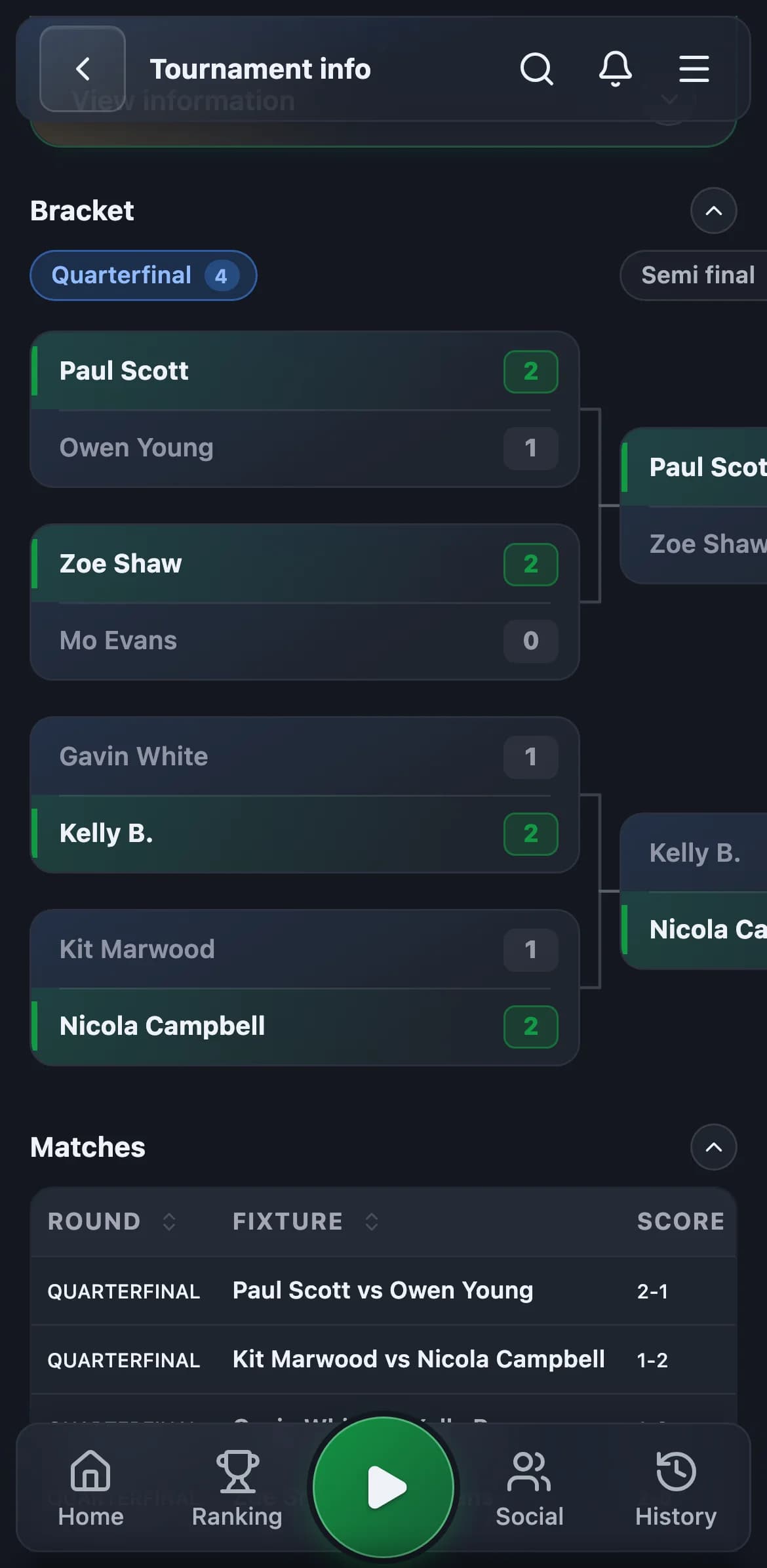
How it plays.
The draw
Players are put in a bracket, either seeded so the strongest can’t meet early or drawn at random.
Byes
With a field that isn’t 8, 16 or 32, some players go straight into round two. That free pass is a bye, and it usually goes to the top seeds.
Each round
Each match is a race to a set number of frames. The winner goes through; the loser is out.
The final
The last two play the final, often over a longer race. The winner is the champion.
How long it takes.
A round plays on several tables at once, so a night is about as long as its rounds, not its matches.
| Players | Rounds | Matches | Each player plays |
|---|---|---|---|
| 8 | 3 | 7 | 1 to 3 |
| 16 | 4 | 15 | 1 to 4 |
| 32 | 5 | 31 | 1 to 5 |
When to pick a knockout.
Good for
- One night with a fixed finish time
- Any size of field, from 4 players to hundreds
- A final everyone stays to watch
Think twice about
- Players who travelled for one match and are out in ten minutes
- A field where one upset sends the favourite home early
- Working out who’s second best: only the final decides a place
Running it on Leadrboard®.
Leadrboard® runs a knockout from the first entry to the champion.
Seeding
Strict ranking by rating, so the highest rated play the lowest; loose ranking, which shuffles the top half and the bottom half; or random.
Byes
To the top seeds, at random, or to the players you choose. Drag any two players to swap them before it starts.
A race for each round
Race to 2 in the early rounds and race to 5 in the final, say. Each round has its own.
Any size
A venue runs knockouts of up to 32 players, an organiser up to 512. Singles, doubles or teams.
Tables called for you
Each match is sent to a free table, and the players are told “Your table is ready”.
Winners go through
One player enters the score and the other accepts it. The winner moves on and both ratings move.
Questions.
How many byes does a knockout need?
Enough to fill the bracket to the next power of two: 8, 16, 32 and so on. Twelve players in a bracket of 16 means four byes, so four players skip the first round and the other eight play it.
What does seeding do in a knockout?
It spreads the strongest players through the bracket so they can’t meet early: seeds 1 and 2 can only meet in the final, and the top four only from the semi-finals. Without seeding, the two best players can meet in the first round.
Is there a third-place match?
Not in a plain knockout: the two losing semi-finalists are joint third. If places matter beyond the final, double elimination or a round robin gives everyone a finishing place.
What if the number of players isn’t 8, 16 or 32?
The bracket is the next size up and the gaps are byes. Thirteen players play in a bracket of 16 with three byes, so three players start in round two, usually the top three seeds.
Draw tonight’s bracket.
Type the names, get a seeded bracket to print. Free, no sign-up.