

Round robin, explained.
Everyone plays everyone, and a table decides the winner. Nobody is knocked out by one bad match.
A round robin is a format where every player plays every other player, once or home and away, and a league table decides the winner. A win usually earns 3 points and a draw 1. Players level on points are split by tie-breaks such as frame difference and head to head. Eight players play 28 matches over seven rounds.
How it plays.
The fixtures
Everyone is paired with everyone else, a round at a time, so each round every player has one match (or a bye when the number is odd).
Points
Each result earns points: 3 for a win, 1 for a draw and 0 for a loss is the usual. A draw is only possible over a set number of frames.
The table
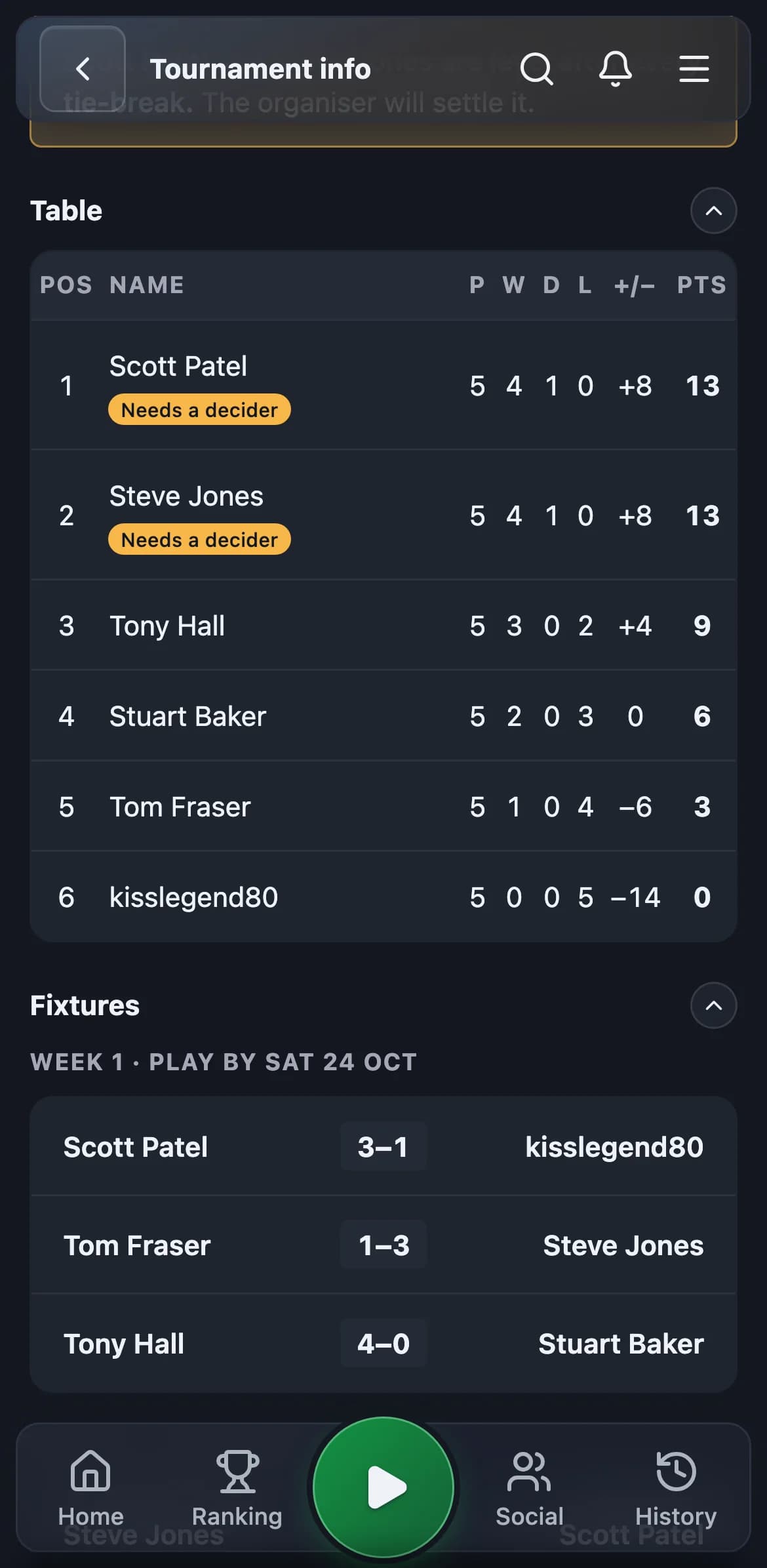
Played, won, drawn and lost, frames for and against, then points. The table changes with every result.
Tie-breaks
Players level on points are split in an agreed order: frame difference, then head to head, for example.
How long it takes.
The matches grow fast: double the players and the matches roughly quadruple. Past a dozen or so, groups then a knockout keeps it to a night.
| Players | Rounds | Matches | Each player plays |
|---|---|---|---|
| 8 | 7 | 28 | 7 |
| 16 | 15 | 120 | 15 |
| 32 | 31 | 496 | 31 |
When to pick a round robin.
Good for
- Every player getting the same number of matches
- A league over weeks, a round each week
- Small groups that feed a knockout
Think twice about
- A big field in one night: the matches grow quickly
- Players dropping out part way: their results have to be dealt with
- A night that needs a dramatic final (add play-offs for one)
Running it on Leadrboard®.
Leadrboard® makes the fixtures, keeps the table and settles ties the way you set.
Four kinds
League, Home and away league, Groups then knockout or League then play-offs.
One night or weekly
Play every round in one session, or a round a week with a play-by date for each.
Match length
A race to a number of frames (always a winner), or a set number of frames played (a level score is a draw).
Points and tie-breaks
Your points for a win, a draw and a loss, extra points for each frame or a whitewash if you like, and the tie-breaks in your order.
Groups
A league holds up to 100 players. Groups then knockout runs bigger fields, and can spread players by rating and keep teammates apart.
Walkovers and withdrawals
Give a walkover for a match never played, and choose what happens to a withdrawn player’s results.
Questions.
How many matches is a round robin?
Each player plays everyone else once, so a field of n plays n × (n − 1) ÷ 2 matches: 28 for 8 players, 120 for 16. Home and away doubles it.
What happens with an odd number of players?
One player sits out each round, and everyone sits out once. Seven players take seven rounds, each player playing six matches.
What if players finish level on points?
The tie-breaks decide, in the order set before the start. Common ones are frame difference, head to head and frames won; in snooker, the highest break can be one. If everything is still level, the organiser can play it off.
What’s the difference between a round robin and a Swiss?
In a round robin everyone plays everyone. In a Swiss everyone plays a set number of rounds, each against a player on the same score, so a big field needs far fewer matches to find its winner.

Run your round robin.
The fixtures, the table and the tie-breaks, kept for you.